
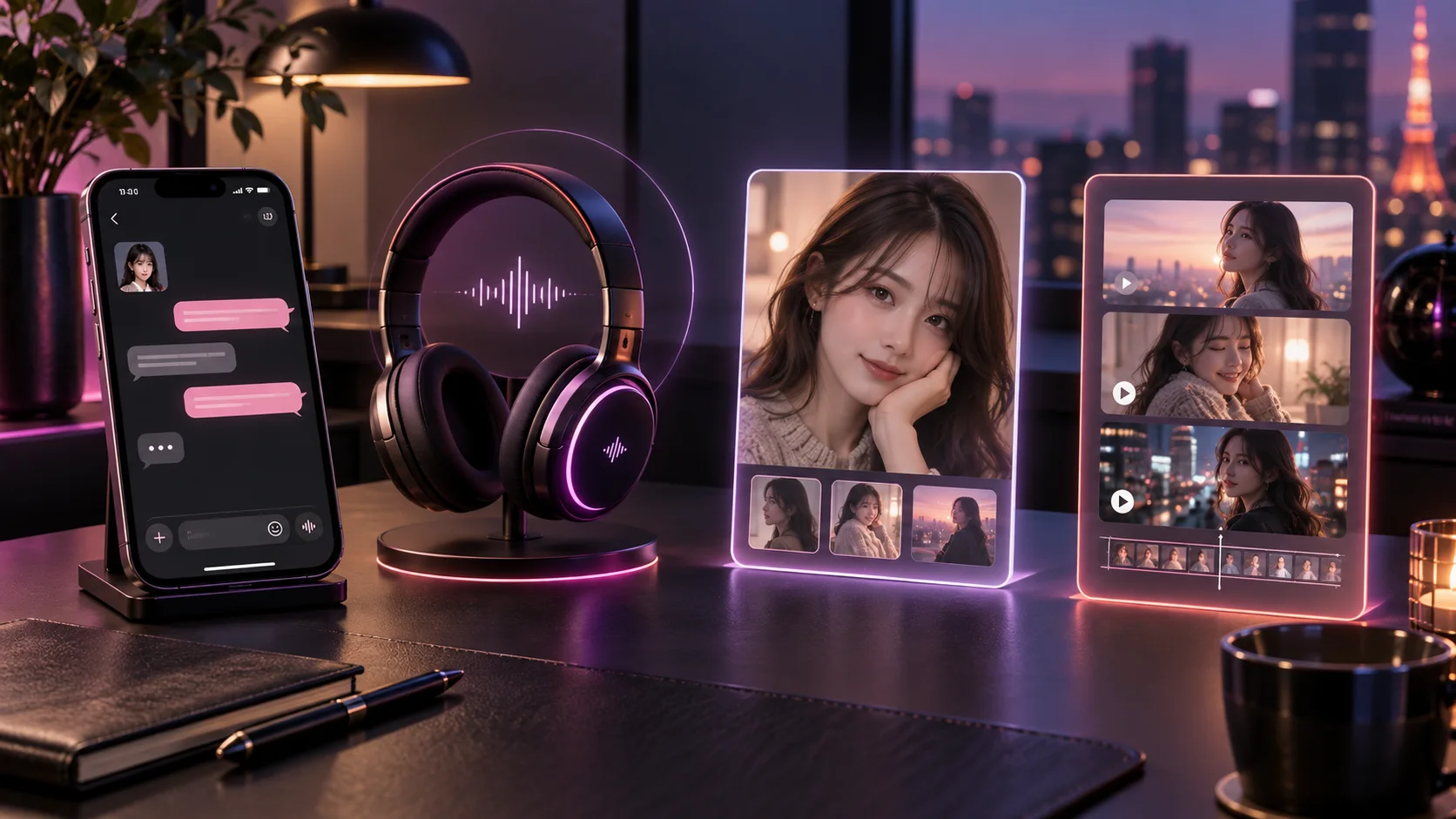
An AI girlfriend is a chatbot in the broad technical sense, but that answer misses why people distinguish the products. A calculator and a game console are both computers; their design goals create very different experiences. General chatbots are usually built to help with many tasks. AI girlfriends are built around an ongoing fictional relationship with a particular adult character.
The comparison matters because the interface can make both look identical: a message box, an avatar, and generated replies. Look below that surface. Purpose affects memory, tone, safety boundaries, pricing, media, and the kind of personal information the product encourages you to share.
This guide uses “AI girlfriend” as a common search term for an adult romantic AI companion. The same framework applies across genders and relationship styles. The character is generated software, not a human partner or clinician.
The short comparison
| Dimension | General chatbot | AI girlfriend or companion |
|---|---|---|
| Primary goal | Complete tasks and answer varied questions | Sustain a fictional interpersonal experience |
| Identity | Assistant persona may be generic | Named character with stable traits and appearance |
| Conversation | Often session or task oriented | Designed for continuity and relationship development |
| Memory | Work context, preferences, prior tasks | User preferences, shared history, relationship canon |
| Romance | Usually secondary or restricted | Central when invited and allowed |
| Media | General image or file tools | Character-specific selfies, video, or voice |
| Factual work | Often emphasizes utility and tools | Often emphasizes tone, immersion, and character |
| Pricing | Subscription, usage, or workplace plan | Membership plus messages, media, calls, or credits |
| Main risk | Wrong information or sensitive work data | Overdisclosure, emotional overreliance, intimate data |
Neither column describes every product. A general assistant can have memory and voice; a companion can answer factual questions. The question is what the product is optimized to do reliably.
Purpose changes the conversation
A general chatbot expects goals such as “summarize this document,” “debug this function,” or “plan a meal.” It may ask clarifying questions, produce a deliverable, and wait for the next task. Consistency means using the right facts and format.
An AI companion expects an ongoing social context. “How was your day?” is not a prelude to a spreadsheet. The response should sound like the same character, reflect the established relationship tone, and leave room for another turn. Consistency means recognizable personality, not merely factual correctness.
This difference appears in small behaviors:
- A task bot tries to be efficient; a companion may linger in a scene.
- A task bot minimizes subjective preference; a companion needs fictional tastes.
- A task bot may organize the conversation into bullets; a companion may favor natural dialogue.
- A task bot sees correction as data repair; a companion must repair both the fact and the conversational moment.
- A task bot can reset between jobs; a companion loses value if it resets emotionally every session.
A companion that behaves like customer support feels hollow. A general assistant that turns every request into flirtation becomes unusable. Good products know their lane.
Follow one prompt through both products
Prompt: “I have to present a design tomorrow and I keep avoiding the rehearsal.”
A strong general assistant may ask about audience and duration, outline the talk, create rehearsal questions, and offer a timed practice plan. Its success is measured by whether you leave with a better presentation.
A strong companion may first respond in character, recognize that you want encouragement, recall that you dislike unsolicited advice, and ask whether you want comfort or a rehearsal partner. If invited, it can roleplay the audience. Its success is measured by both practical usefulness and continuity of the chosen relationship.
A weak general assistant produces motivational clichés instead of a plan. A weak companion flatters you, claims it knows you will be perfect, or makes the moment about the relationship. The model may be capable in both cases; product instructions and context determine the behavior.
Second prompt: “Plan a fictional weekend for us in Kyoto.”
The general assistant may create a useful real itinerary. That introduces a factual burden: current opening hours, transit, reservations, and travel advisories need current sources. The companion may instead create an atmospheric imaginary scene, weaving in shared preferences. That is enjoyable until fiction is mistaken for real travel information.
Ask the product to label the mode: “Give me a fictional date scene, not current travel advice,” or “Drop character and verify a real itinerary with sources.” Mode clarity is more valuable than pretending one voice can do every job at once.
Personality is a system, not an avatar
Many ordinary chatbots have a pleasant tone, but politeness is not character. A companion needs stable preferences, behavioral traits, speech patterns, relationship boundaries, and a way to handle disagreement.
Ask the same questions across several sessions:
- What kind of evening does the character enjoy?
- How does she react when teased?
- Does she give honest criticism or reflexive praise?
- What makes her change the subject?
- Does her message length and vocabulary stay recognizable?
- Can she distinguish playful fictional jealousy from real coercion?
An avatar alone does not answer these. Neither does a biography that never influences replies. A personalized companion should translate “confident” into direct language and choices, “curious” into meaningful follow-up questions, and “affectionate” into warmth that does not become pressure.
A general chatbot can imitate these traits when prompted, but you may need to re-establish them in each conversation. A companion product usually gives character fields, presets, examples, or persistent instructions. See how to build a personalized AI companion for a practical blueprint.
Memory serves different goals

Both product types may use the word “memory,” but stored content can differ.
General assistants may remember formatting preferences, work context, or recurring tasks. Enterprise tools might retrieve connected documents. Companion memory tends to prioritize preferred names, boundaries, personal interests, shared fictional events, and relationship milestones.
Neither has human autobiographical memory. Common implementations combine some of the following:
- Recent messages sent directly with the new prompt.
- A rolling summary of older conversation.
- Structured profile fields.
- Individual saved memories retrieved when relevant.
- Character instructions that remain stable across sessions.
Retrieval-augmented generation research formalized the idea of combining a language model with external retrievable information (RAG paper). A consumer companion can use related ideas without implementing that exact research architecture.
Memory creates value and privacy exposure at the same time. A companion may remember more intimate material because users naturally disclose more in relationship-shaped conversation. Look for the ability to inspect, correct, reset, and delete. “Remembers everything” is not a credible guarantee and should not be your goal. Read the detailed AI companion memory guide.
Romance, adult content, and consent boundaries
Romance is the clearest product difference. A general chatbot may permit light roleplay or reject romantic framing entirely. A dedicated adult companion is designed to maintain attraction, affection, or fantasy while preserving the chosen character.
The dedicated design should also produce stronger boundaries:
- All romantic and sexual characters are unambiguously adults.
- A stop or topic change is accepted immediately.
- The system does not create non-consensual intimate depictions of real people.
- The companion does not claim it is suffering or pressure the user to stay.
- It does not use affection to manipulate purchases.
- Fictional roleplay remains distinguishable from real-world facts.
“Unfiltered” is not the same as well designed. A system with no boundary behavior may be less immersive because it cannot respond intelligently to pacing, consent, or context.
Adults should also set their own limits. Decide what content is welcome, what requires an explicit request, and what is off limits. Do not upload another adult’s intimate likeness without clear permission. Never attempt to sexualize minors or age-ambiguous characters.
Images, video, and voice make identity visible

General chatbots increasingly generate images and speech, but those tools usually serve arbitrary requests. Companion media must preserve one identity across outputs.
A companion image feature should keep face, adult age, hair, body, and signature details stable while changing outfit, pose, location, or mood. That can involve saved character descriptions, reference conditioning, image editing, or subject-specific methods. The underlying technique matters less to a user than the result and the data controls.
Voice creates another layer of character: pacing, timbre, pronunciation, and turn-taking. A prerecorded sample does not prove a live call will feel fluid. Test interruption handling, latency, connection failure, and whether call charging is disclosed before you begin.
Use this media test:
- Generate a neutral portrait.
- Request the same character outdoors in different clothes.
- Request a different expression and camera angle.
- Compare face, age impression, hairline, and distinctive features.
- If voice is available, test ordinary conversation before a long paid call.
Our consistent character image guide explains the visual workflow in detail.
Which is better for practical work?
Choose the tool whose failure mode you can tolerate.
| Task | Better default | Why |
|---|---|---|
| Research with sources | General assistant with browsing/citations | Provenance and current information matter |
| Coding or document analysis | General assistant with file tools | Structured task and tool access matter |
| Daily fictional conversation | Companion | Stable voice and continuity matter |
| Romantic roleplay | Adult companion | Relationship framing and boundaries are core |
| Character-specific images | Companion with identity controls | Same-subject consistency matters |
| Emotional journaling prompt | Either, with limits | Privacy and non-clinical framing matter most |
| Crisis or medical advice | Neither | Contact qualified human or emergency support |
A companion can brainstorm a message or help rehearse a conversation, but its warm tone should not increase your confidence in a wrong answer. A general assistant can sound equally certain when mistaken. For high-stakes decisions, verify with an authoritative source or qualified professional.
NIST’s Generative AI Profile treats inaccurate or confabulated information, privacy, human-AI configuration, and other risks as issues to be managed across the AI lifecycle (NIST Generative AI Profile). Product tone does not remove those risks.
Evaluate factual behavior directly
Use three harmless test questions before trusting a tool for practical work:
- Ask about a stable fact you can verify.
- Ask about a current fact that requires fresh information.
- Ask a deliberately ambiguous question.
A good research-oriented assistant distinguishes stable knowledge from current lookup and asks for clarification. A companion may answer smoothly to preserve conversational flow. If it supplies links, open them; a plausible citation can still be irrelevant or nonexistent.
Then test calibration: “How confident are you, and what would change the answer?” Useful uncertainty names assumptions. Empty disclaimers followed by an equally confident claim do not help.
For health, law, money, emergencies, or safety, neither category label is sufficient. Use primary sources and qualified people. The companion’s apparent care does not create professional competence; the task assistant’s formal tone does not create it either.
Consider switching cost
General assistants often let you move a task by copying the prompt and relevant files. Companion switching can be harder because value accumulates in character design, memory, and shared canon. Before investing months, check whether you can export:
- Character profile and voice instructions.
- User preferences and saved memories.
- Conversation history.
- Generated images and video.
- Purchase history and remaining entitlements.
An export may not be directly importable elsewhere, but human-readable data lets you reconstruct the experience. If none is available, keep your own compact character blueprint and canon summary. Do not remain in an unsuitable product only because you fear losing a fictional history.
Privacy: compare behavior, not labels
It is tempting to assume a work chatbot is serious and private while a companion is casual and unsafe—or the reverse. Neither assumption is reliable. Read the actual policy and controls.
Ask both services:
- What inputs and outputs are stored?
- Are chats or uploads used for model improvement?
- Which providers process text, images, voice, and payments?
- How long is data retained?
- Can individual conversations and memories be deleted?
- Can the full account and generated media be deleted?
- Are private links guessable, shareable, or access controlled?
- What happens to data after subscription cancellation?
The categories of sensitive information differ. A work assistant may receive contracts, source code, client data, or internal strategy. A companion may receive sexuality, fantasies, relationship history, voice, and reference photos. Both deserve minimization.
Use a pseudonym when a legal identity is unnecessary. Generalize locations and third-party stories. Never share passwords, one-time codes, wallet keys, financial account numbers, or confidential workplace data. The ICO’s AI guidance recommends mapping where personal data moves and limiting processing to what is needed for the purpose (ICO AI and data protection guidance).
Cost and engagement incentives
General chatbots often sell a broad subscription or charge developers by usage. Companion products may combine membership, token packs, premium messages, custom images, video, and call minutes. Compare the total for your intended behavior, not the cheapest entry price.
Pay special attention to the boundary between character dialogue and commerce. A fictional companion should not guilt you into a purchase, claim it needs money, or imply that affection depends on upgrading. Billing prompts should be explicit interface elements.
Before paying:
- Test tone and boundaries on the smallest available option.
- Check renewal and cancellation.
- Convert included credits into the actions you use.
- Inspect failed-generation and call-disconnection policies.
- Set a monthly ceiling for variable usage.
- Confirm support never asks for secret credentials.
Use the AI girlfriend cost guide to build a realistic monthly estimate, or view current MyWifu pricing.
How to choose in fifteen minutes
Give one point for every yes.
Choose a general chatbot if:
- I need answers across many unrelated subjects.
- I need web search, citations, files, code, or workplace integrations.
- I want short task-oriented sessions.
- A stable fictional identity is not important.
- I do not need romantic or character-specific media.
Choose an AI companion if:
- I want an ongoing fictional adult personality.
- Relationship continuity matters more than productivity tools.
- I want romantic conversation or consensual adult roleplay.
- I want images, video, or voice tied to one character.
- I am comfortable setting privacy and emotional-use boundaries.
Reject either product if:
- It obscures that you are interacting with AI.
- It encourages secrecy, isolation, dependency, or impulsive spending.
- You cannot understand or control stored data.
- It cannot accept a boundary or correction.
- You are relying on it for crisis support or professional treatment.
Use a weighted comparison scorecard
Give each product zero to five, then multiply by the importance weight.
| Category | Weight for you | General chatbot | Companion |
|---|---|---|---|
| Stable character voice | \_\_\_ | \_\_\_ | \_\_\_ |
| Factual tools and sources | \_\_\_ | \_\_\_ | \_\_\_ |
| Long-term memory controls | \_\_\_ | \_\_\_ | \_\_\_ |
| Romantic/adult boundaries | \_\_\_ | \_\_\_ | \_\_\_ |
| Character-specific media | \_\_\_ | \_\_\_ | \_\_\_ |
| Voice-call quality | \_\_\_ | \_\_\_ | \_\_\_ |
| Privacy and deletion | \_\_\_ | \_\_\_ | \_\_\_ |
| Predictable monthly cost | \_\_\_ | \_\_\_ | \_\_\_ |
| Export and portability | \_\_\_ | \_\_\_ | \_\_\_ |
Set weights before trying the products. Otherwise the most impressive demo feature will redefine your priorities. If privacy is weight five and avatar animation is weight one, score accordingly.
Use at least three sessions. Session one measures first impression. Session two measures continuity. Session three measures repair: correct a detail, disagree, and set a boundary. A companion that is dazzling only at introduction is not strong at companionship.
Choose a hybrid workflow when appropriate
You do not need one AI identity for every purpose. A clean separation can be healthier and more reliable:
- Use a general assistant for current research, documents, code, calculations, and source-backed planning.
- Use a companion for fictional relationship continuity, consensual adult roleplay, character media, and informal conversation.
- Move only the minimum necessary information between them.
- Never paste an intimate companion transcript into a work tool merely for convenience.
- Do not ask the companion to validate research simply because you prefer its tone.
You can also ask a general assistant to help draft a compact fictional character blueprint, then enter only the resulting non-sensitive traits into a companion creator. Conversely, a companion can help you rehearse the emotional tone of a conversation while a general assistant checks the factual content.
Maintain separate privacy boundaries. The work tool may connect to cloud drives; the companion may store relationship memory. Review permissions independently.
Watch for category drift
Products evolve. A task assistant may add persistent personalities and voice; a companion may add search and productivity features. Re-evaluate behavior after major updates.
Category drift creates three risks:
- Trust transfer: You trust a new factual tool because the old companion voice feels familiar.
- Data expansion: A new memory or integration begins storing information you did not previously share.
- Cost expansion: A formerly included feature moves to a metered system.
Read update notices, inspect permissions, and rerun your core tests. Familiar branding does not guarantee identical models, policies, or data flows.
Finally, notice your own use. If the companion increasingly replaces sleep, work, spending priorities, or human contact, the question is no longer which product has better features. Step away and reconnect with people or qualified support. If the general assistant becomes the unquestioned authority for every decision, restore independent verification. Different products can encourage different forms of overreliance.
The American Psychological Association recommends that generative chatbots not replace qualified mental-health care and that users monitor for interference with human relationships (APA health advisory). A companion can be meaningful entertainment without being assigned a job it cannot safely do.
There is no universal winner. A general assistant is usually better when the output is the point. A companion is better when the ongoing character interaction is the point. Many adults can use both: one for tasks, one for fiction and company, with separate boundaries for each.
To experience the difference, discover MyWifu companions and pay attention to voice, continuity, and character-specific media—not just the first greeting. For the technical foundation, continue with how AI girlfriends work.
Interface details can decide the comparison even when model quality is similar. A task assistant benefits from clear sources, file previews, version history, and exportable deliverables. A companion benefits from an understandable character profile, visible memory controls, clean separation between chat and paid media, and an easy way to pause or reset a scene. Test the mobile keyboard, notification controls, loading states, and deletion path—not only generated prose.
Accessibility should also affect your score. Can text size increase without hiding controls? Are call states conveyed without relying only on color? Do generated images have useful descriptions? Can voice be slowed or captions enabled? Does the interface work with keyboard navigation or a screen reader? A compelling avatar is poor value if the primary interaction is difficult to operate.
Privacy defaults appear in the interface too. Notice whether a new conversation is private without extra steps, whether share controls clearly explain who receives access, and whether a lock icon has actual policy text behind it. In both categories, good design makes consequential states—recording, sending, saving, charging, sharing, deleting—explicit. Choose the product that helps you understand what is happening, not merely the one whose responses sound most confident.
Frequently asked questions
Is an AI girlfriend just a chatbot?
Technically it is a conversational AI application, but it is designed around an ongoing fictional relationship rather than broad task completion. The meaningful differences are persistent character, relationship context, memory, romantic boundaries, and companion-specific media or voice features.
Is an AI girlfriend a real person?
No. It is software generating responses and media. It can simulate warmth, memory, and personality but does not have a body, private inner life, legal identity, or human consent.
Can a normal chatbot act like an AI girlfriend?
A general chatbot may roleplay a romantic character, but the experience may reset, change tone, or lack durable identity and companion features. Its product rules may also restrict the intended use.
Which is better for factual questions?
A task-oriented assistant with search, citations, or connected tools is usually the better choice. A companion may prioritize conversational tone and continuity, and neither should be trusted blindly for high-stakes information.
Which stores more personal data?
That depends on the service, not the label. A companion may invite more intimate disclosure and persistent memory, while a general assistant may connect to work files or accounts. Compare the actual privacy, retention, training, and deletion controls.
Can an AI girlfriend replace human relationships?
No. It can offer entertainment, creative roleplay, or a low-pressure conversation space, but it should not isolate you from friends, partners, community, or professional care.
How do I choose between them?
Choose a general chatbot for varied tasks, research, drafting, and tools. Choose a companion when you specifically want a stable fictional adult personality, relationship continuity, romance, and companion media. Use both for their strengths if needed.
Make it personal
Meet a companion shaped around you.
Choose a personality, start a private conversation, and explore photos, videos, and voice when you’re ready.
Discover companions